Walk into almost any factory today, and you will find a small box sitting quietly inside a control panel, running the whole show. Conveyors start and stop on time, pumps kick in at the right pressure, and packing machines keep a steady rhythm. Behind the scenes, an industrial PLC runs the show.
If you are a plant owner, maintenance engineer, or someone just starting in automation, understanding what a PLC does will help you make better buying decisions and fix problems faster. In this guide, we break it down in plain language, without the textbook jargon.
Key takeaways
- An industrial PLC is a rugged computer that controls machines and processes in harsh factory conditions.
- It works in a continuous scan cycle: read the inputs, run the program, update the outputs, and repeat.
- Siemens, Mitsubishi Electric, Allen-Bradley, and Delta are among the most widely used PLC brands, with Mitsubishi and Siemens especially common in India.
- Compact PLCs suit single machines, modular PLCs suit large and growing lines, and micro modular PLCs fit tight panels.
- The right PLC depends on your I/O count, speed, communication network, environment, support, and budget.
- Ladder logic is the most common programming language, which makes PLCs easy for electricians and technicians to pick up.
What is an industrial PLC?
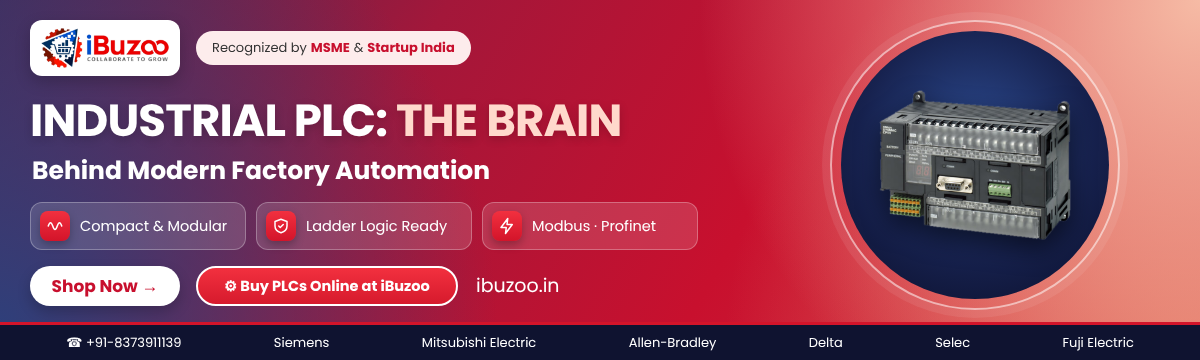
An industrial PLC, or Programmable Logic Controller, is a rugged digital computer built to control machines and processes on the shop floor. Think of it as the brain of a machine. It reads signals from sensors and switches, decides what should happen next based on a program you write, and then tells motors, valves, and lights what to do.
What makes it "industrial" is how tough it is. A regular office computer would struggle in a hot, dusty plant full of electrical noise and vibration. A PLC is designed for exactly that environment. It can run for years without a restart, handle temperature swings, and keep working when the power supply is less than perfect.
Before PLCs came along, factories used huge panels packed with relays and timers. Changing a single step in the process meant rewiring half the cabinet. With a PLC, you simply change the program on a laptop and download it. That flexibility is the main reason PLCs took over industrial control and never looked back.
What does a PLC do and how does it work?
At its core, a PLC does three things over and over: it reads, it thinks, and it acts. This loop is called the scan cycle, and it usually repeats many times every second.
- Read the inputs. The PLC checks every connected input, such as push buttons, limit switches, proximity sensors, temperature probes, and pressure transmitters. It takes a snapshot of their current state.
- Run the program. Using that snapshot, the PLC works through the logic you have written. For example: if the box sensor is on and the guard door is closed, start the conveyor.
- Update the outputs. Based on the result, it switches outputs on or off. That could mean starting a motor through a contactor, opening a solenoid valve, or turning on a warning lamp.
- Housekeeping. It also runs self-checks and handles communication with HMIs, drives, and other controllers before starting the next scan.
Inside the box, you will typically find a CPU that runs the program, memory to store it, a power supply, and input/output (I/O) modules that connect to the field devices. Digital I/O handles simple on and off signals, while analog I/O deals with changing values like temperature, flow, or speed.
Most PLCs are programmed in ladder logic, which looks a lot like the old relay wiring diagrams electricians already know. Other languages such as function block diagram and structured text are also common, especially for more complex machines.
In day to day terms, a PLC might count bottles on a filling line, maintain the temperature in a furnace, sequence the steps of a robotic cell, or shut a machine down safely when someone opens a guard.
Which PLC is mostly used in industry?
There is no single winner, but a handful of brands show up in most plants. Which one you see depends a lot on the industry, the region, and what the machine builder prefers.
Siemens is one of the most widely used PLC brands in the world. Its S7-1200 and S7-1500 series are common in automotive, process, and large manufacturing plants, and the TIA Portal software ties everything together.
Mitsubishi Electric is extremely popular in India and across Asia. The FX5U is a favourite for standalone machines, while the iQ-R and Q Series handle large, demanding lines. Many OEMs choose Mitsubishi because it is reliable and easy to get support for locally.
Allen-Bradley (Rockwell Automation) dominates in North America. CompactLogix and ControlLogix are the go-to choice in many plants following US standards.
Delta Electronics has earned a strong following for budget-friendly machines. The DVP and AS series offer solid performance at a price that suits small and mid-sized manufacturers.
Selec, GIC, Fuji Electric, and Renu are practical options for cost-sensitive and compact applications, and they are widely used by panel builders in India.
So which one should you pick? In most cases, the best PLC is the one your team already knows, your machine builder supports, and your local supplier can service quickly.
Compact, modular, or micro modular PLC?
Industrial PLCs generally come in three formats, and choosing the right one saves money and headaches later.
A compact PLC has the CPU, power supply, and a fixed number of I/O points built into one unit. It is affordable, quick to install, and perfect for single machines like a packing unit or a small pump station.
A modular PLC lets you build the system piece by piece. You start with a CPU and add I/O modules, communication cards, and special function modules as needed. It costs more upfront, but it is the smart choice for large lines and plants that expect to grow.
A micro modular PLC sits between the two. It is small enough for tight panels but still lets you add a few expansion cards when the application demands it.
How to choose the right industrial PLC
Before you place an order, run through these quick checks:
- Count your I/O. List every digital and analog signal, then add around 20 percent spare for future changes.
- Check the speed. High-speed counting, motion control, or fast packaging lines need a CPU that can keep up.
- Match the communication. Make sure the PLC supports the network your plant already uses, such as Ethernet/IP, Modbus, Profinet, or CC-Link.
- Think about the environment. Heat, dust, moisture, and electrical noise all affect which model and enclosure you need.
- Look at software and support. Programming software, spare parts, and local technical help matter just as much as the hardware.
- Plan your budget honestly. The cheapest unit is not always the cheapest choice once downtime enters the picture.
Buy industrial PLCs online at iBuzoo
A good PLC is something you install once and then forget about, because it simply keeps working. At iBuzoo, we stock genuine industrial PLCs from trusted brands including Mitsubishi Electric, Siemens, Delta Electronics, Fuji Electric, Selec, GIC, and Renu Electronics. You will find compact PLCs, modular PLCs, micro modular PLCs, I/O modules, power supplies, and all the cables and accessories that go with them.
Not sure which model fits your machine? Share your requirements through the Enquire Now button on any product, or write to us at sales@ibuzoo.in. Our team will help you pick the right CPU and I/O, and send a clear quote with delivery across India and to Nepal.
Frequently asked questions
What is the full form of PLC?
PLC stands for Programmable Logic Controller. It is a digital controller used to automate machines and industrial processes.
What is the difference between a PLC and a relay panel?
A relay panel uses physical wiring to create control logic, so every change means rewiring. A PLC does the same job through software. You can change the logic on a laptop in minutes, troubleshoot faster, and save a lot of panel space.
What is the difference between PLC, SCADA, and HMI?
The PLC controls the machine. An HMI is the screen operators use to see what is happening and give commands. SCADA is software that monitors and controls many PLCs across a plant or multiple sites. They work together, but the PLC is the one doing the actual control.
Is a PLC the same as a DCS?
Not quite. A PLC is ideal for fast, machine-level control and discrete manufacturing. A DCS (Distributed Control System) is built for large continuous processes like refineries, chemical plants, and power stations. Modern PLCs have grown powerful enough to handle many process applications too.
Which programming language is used for PLCs?
Ladder logic is the most popular because it looks like electrical wiring diagrams. Function block diagram, structured text, and sequential function chart are also widely used. Most of these are defined under the IEC 61131-3 standard.
How long does an industrial PLC last?
A good quality PLC installed in a proper panel can run reliably for 10 to 20 years. In practice, plants often upgrade earlier because spare parts become hard to find or the old model is discontinued.
Is it hard to learn PLC programming?
Not really. If you understand basic electrical circuits, ladder logic will feel familiar. Many engineers start with a small compact PLC, practice simple start and stop circuits, and build up from there.
Can I connect a PLC to the internet or IoT systems?
Yes. Most modern PLCs support Ethernet and protocols like Modbus TCP, OPC UA, or MQTT through add on modules or gateways. This lets you send machine data to dashboards, cloud platforms, and maintenance systems.